
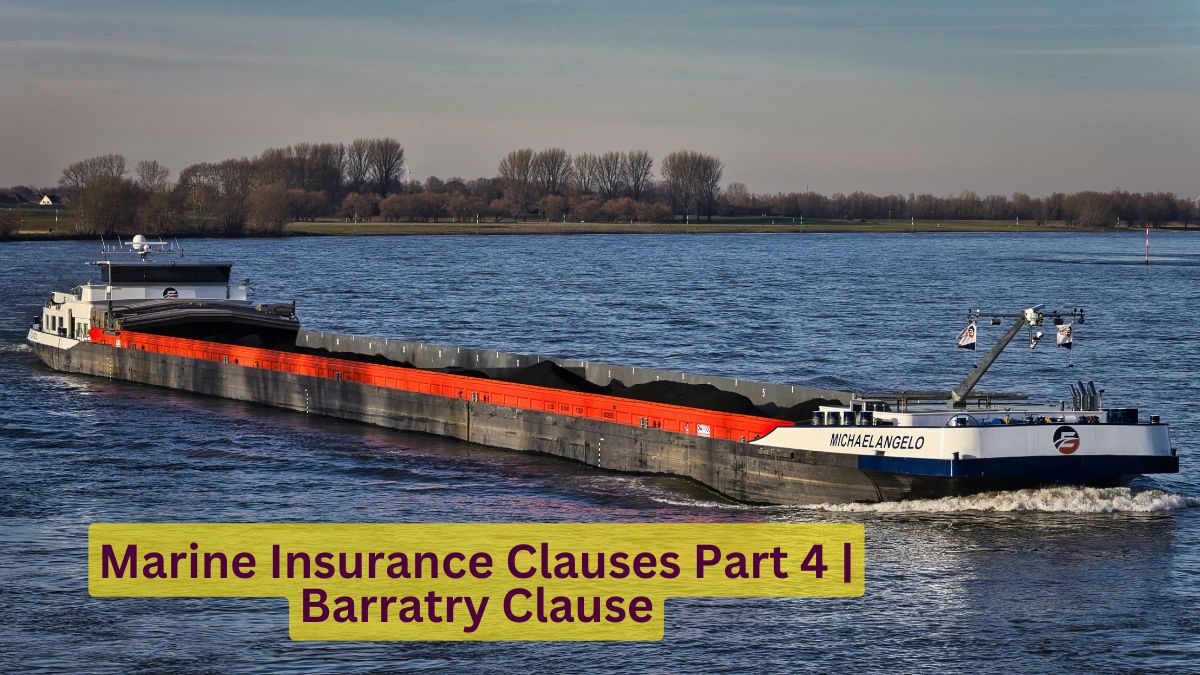
When discussing marine insurance risks, most professionals immediately think of external perils — storms, collisions, piracy, or accidents at sea. However, not all risks originate outside the vessel.
In some cases, the greatest threat comes from within the ship itself — from the very individuals entrusted with its operation. This is where the Barratry Clause becomes a critical component of marine insurance.
What Is Barratry?
Barratry refers to fraudulent, criminal, or intentional wrongful acts committed by the ship’s master or crew, carried out against the interests of the shipowner.
These are not accidental errors or negligence. Barratry involves deliberate misconduct that results in loss or damage to the vessel or cargo.
Examples of barratry may include:
- Deliberate damage to the vessel
- Theft or misappropriation of cargo
- Unauthorized deviation from the agreed voyage
- Illegal trading activities for personal gain
How the Barratry Clause Works
The Barratry Clause provides insurance coverage for losses arising from such intentional misconduct, subject to policy terms and conditions.
However, two critical conditions must be satisfied:
- The act must be against the interest of the shipowner
- The shipowner must not have consented to or been involved in the act
If the owner is complicit or aware of the wrongdoing, the clause will not respond.
Example 1: Unauthorized Diversion and Illegal Trade
A vessel is contracted to transport goods along a defined route. During the voyage, the captain deliberately diverts the vessel to an unauthorized port to engage in illegal trade activities for personal gain.
As a result, part of the cargo is lost and the remainder is delayed significantly.
* The loss may be covered under the Barratry Clause, provided the shipowner had no knowledge or involvement in the deviation.
Example 2: Theft of Cargo by Crew Members
During transit, crew members intentionally remove and sell part of the cargo without authorization. The loss is discovered upon arrival at the destination port.
* This may qualify as barratry because the loss arises from deliberate wrongful acts committed by the crew against the interests of the shipowner.
Again, coverage applies only if the shipowner was not complicit in the act.
Key Principle: Internal Misconduct vs External Perils
A critical distinction in marine insurance is the difference between external risks and internal misconduct.
Barratry is not triggered by environmental or accidental events. It specifically addresses breach of trust by those in control of the vessel.
This makes it fundamentally different from perils such as storms, collisions, or grounding.
Why the Barratry Clause Matters
Marine operations involve multiple parties, long distances, and limited direct oversight from shipowners. This creates inherent exposure to human risk within the vessel’s crew and management.
The Barratry Clause acts as a safeguard against this internal risk, ensuring that insured parties are not left exposed when losses arise from intentional misconduct.
Without this clause, certain losses caused by crew actions could fall outside the scope of standard marine coverage.
Common Areas of Dispute
Claims involving barratry can be complex and often hinge on factual and legal interpretation.
- Whether the act was truly intentional or merely negligent
- Whether the shipowner had knowledge or involvement
- Whether the act directly caused the loss
- Classification of the act under policy wording
These disputes often require detailed investigation, including crew records, voyage data, and contractual documentation.
Key Takeaways
- Barratry refers to intentional misconduct by the ship’s crew against the shipowner’s interests.
- The clause covers losses caused by fraud, theft, or unauthorized acts during a voyage.
- Coverage applies only when the shipowner is not involved in the wrongdoing.
- It addresses internal risks, not external marine perils.
- Understanding barratry is essential for accurate marine claims assessment.