
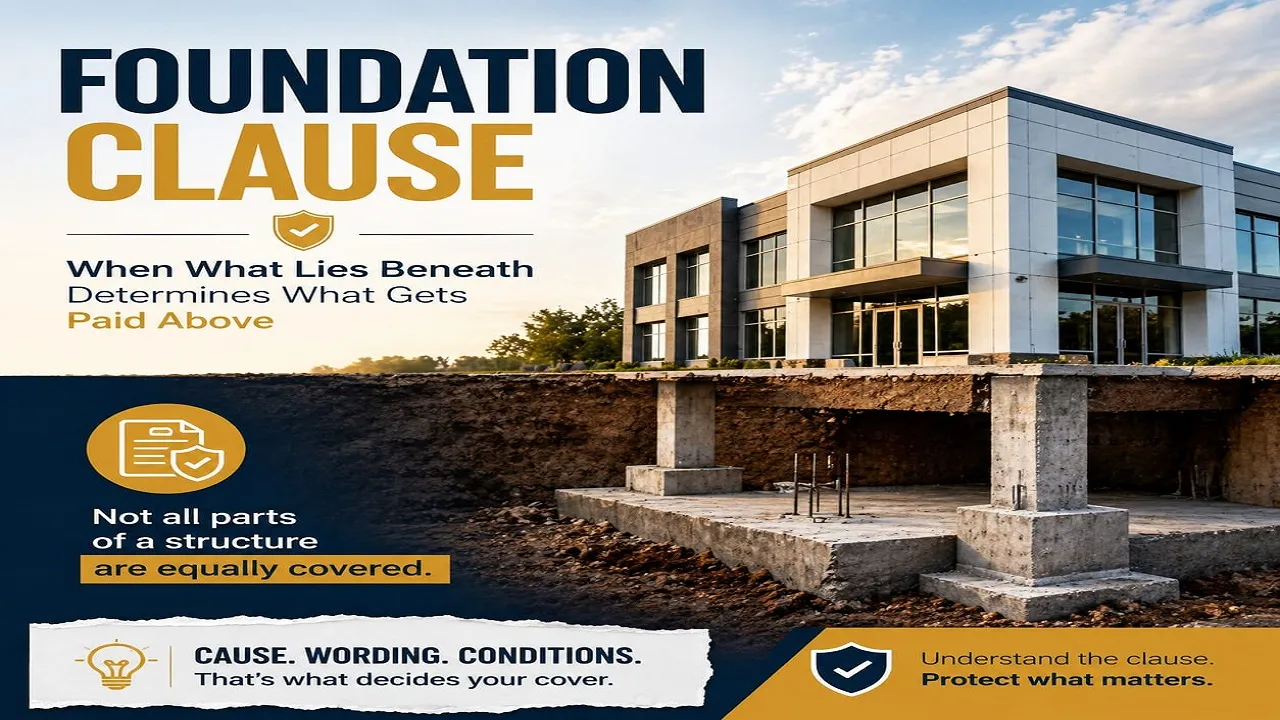
In property and engineering insurance, buildings are often viewed as single structures. However, insurance policies do not always treat every part of a building equally.
What lies beneath the surface — foundations, basements, piling, and underground supports — may be subject to entirely different coverage rules from the visible structure above ground.
This is where the Foundation Clause becomes important.
What Is a Foundation Clause?
A Foundation Clause is a policy provision that defines whether and to what extent foundations and underground structures are covered under a property or engineering insurance policy.
Depending on policy wording, the clause may:
- Exclude foundations entirely
- Limit coverage for underground structures
- Provide cover only under specific conditions
In practical terms:
Insurance may cover what is visible above ground — but not always the structures supporting it below.
What Counts as “Foundation”?
In insurance terminology, foundations generally include structural components located below ground level.
These may include:
- Substructures below ground
- Concrete footings and base slabs
- Basement walls
- Piling and underground supports
Although these components are critical to the structural integrity of a building, they are often difficult to inspect, assess, and repair.
Why Insurers Treat Foundations Differently
Foundation damage presents unique underwriting challenges.
In many cases:
- Damage develops progressively and remains hidden for long periods
- Repairs are technically complex and extremely costly
- Causes such as soil movement or water ingress are difficult to control
- Assessment often requires engineering investigation
Because of these factors, insurers frequently restrict or condition coverage for below-ground structures.
How Insurers Assess Foundation Claims
When foundation-related damage occurs, insurers evaluate several key elements before determining coverage.
- Cause of loss: Was the damage caused by fire, flood, settlement, or another peril?
- Policy wording: Does the policy include or restrict foundation coverage?
- Extent of damage: Is the damage above ground, below ground, or both?
The outcome depends not only on the existence of damage, but also on the interaction between the cause of loss and policy wording.
The Critical Distinction: Above Ground vs Below Ground
One of the most misunderstood aspects of foundation claims is the assumption that structural damage automatically means full insurance cover.
In reality:
- Above-ground damage is commonly covered under standard property policies
- Below-ground damage is often restricted, limited, or excluded
This distinction becomes especially important in losses involving settlement, subsidence, or flood undermining.
Practical Examples
Example 1: Fire Affecting Foundations
A severe fire damages a commercial building, including heat damage to sections of the foundation structure.
Result:
- If foundations are specifically included under the policy, repair costs may be covered
- If restricted or excluded, recovery may apply only to above-ground damage
Example 2: Settlement and Soil Movement
A building develops structural cracking due to gradual soil settlement beneath the foundations.
Result:
- Claims are commonly declined because settlement and soil movement are typically excluded perils
Example 3: Flood Undermining Foundations
Floodwaters erode soil beneath a building, weakening underground supports and causing structural instability.
Result:
- Coverage depends heavily on flood wording, foundation restrictions, and applicable exclusions
Why This Clause Matters
Foundation-related losses can involve substantial repair costs and complex engineering work. Yet many insureds assume that because the building itself is insured, all structural components are automatically covered.
In practice, foundation coverage is often narrower than expected. This makes it essential for insureds, brokers, and underwriters to understand exactly how the policy treats underground structures.
The Foundation Clause ultimately highlights a core principle of insurance:
Coverage depends not only on visible damage, but also on policy wording and the nature of the underlying risk.
Master Insurance Clauses with Real-World Explanations
Explore deeper clause interpretation, underwriting intent, practical claim scenarios, and policy wording analysis in the Insurance Clauses Simplified ebook.
View Clauses EbookKey Takeaways
- Foundation Clauses determine whether underground structures are covered or restricted.
- Coverage outcomes depend on both cause of loss and policy wording.
- Above-ground damage is often treated differently from below-ground structural damage.
- Settlement, soil movement, and hidden deterioration are commonly restricted exposures.
- Understanding foundation wording is critical in property and engineering claims.