
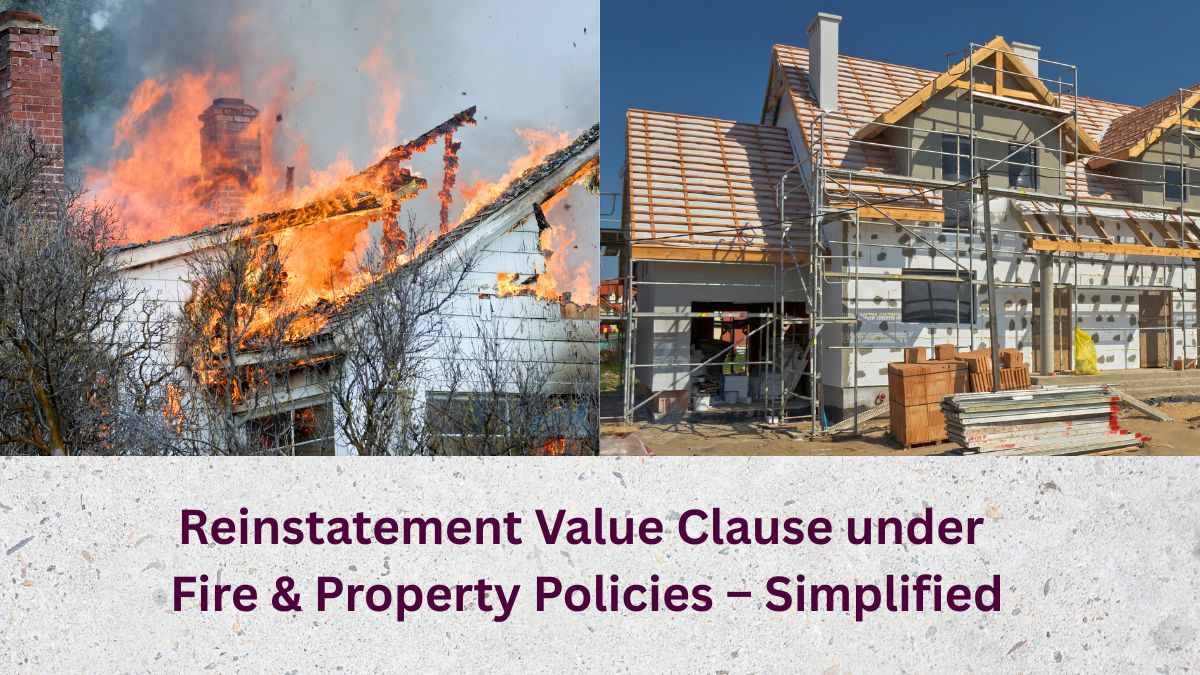
The Reinstatement Value Clause is a critical feature in fire and property insurance policies, designed to ensure damaged assets are fully restored rather than settled at depreciated or market values.
For asset-intensive businesses, this clause often determines whether insurance supports true business continuity or leaves the insured exposed to significant funding gaps after a loss.
Below is a practical explanation of how the Reinstatement Value Clause operates in real claims scenarios.
1. What the Reinstatement Value Clause Is
The Reinstatement Value Clause allows insured property to be repaired, replaced, or rebuilt to a condition equivalent to when it was new, without deduction for age, wear, or depreciation.
Without this clause, claims are settled on an indemnity basis—factoring in depreciation—which can leave insureds unable to replace damaged property using claim proceeds alone.
2. How the Clause Is Applied in Practice
When operative, the insurer pays the full cost of reinstatement, provided strict policy conditions are met.
- The insured must actually repair, replace, or rebuild the damaged property
- Reinstatement must occur within a defined policy timeframe, commonly 12–24 months
- The sum insured must represent full reinstatement value
- Failure to reinstate may cause settlement to revert to depreciated value
These requirements mirror broader claims principles, where timing, documentation, and compliance directly influence outcomes—particularly in legally driven claims such as Professional Indemnity (PI) Insurance claims.
3. Businesses Best Suited for the Clause
The Reinstatement Value Clause is most suitable for businesses that rely heavily on physical assets and cannot absorb depreciation losses.
- Commercial offices and business premises
- Manufacturing plants and factories
- Hotels, hospitals, and educational institutions
- Warehouses and industrial facilities
4. Key Underwriting Considerations
From an underwriting and risk management perspective, the effectiveness of this clause depends on disciplined valuation and policy maintenance.
- Accuracy of declared reinstatement values
- Availability of professional valuation reports
- Inflation exposure and indexation provisions
- Compliance with the average clause
Valuation discipline also plays a central role in how claims are assessed across insurance classes, as outlined in Claims Workflow Simplified.
5. Common Limitations & Exclusions
While powerful, the Reinstatement Value Clause is subject to important conditions and exclusions.
- No cover for betterment or upgrades beyond original specification
- No cover if reinstatement is delayed beyond policy timelines
- Average applies where the property is underinsured
Key Takeaways
- The clause restores assets on a new-for-old basis.
- Accurate reinstatement values are essential.
- Reinstatement must be completed within policy timelines.